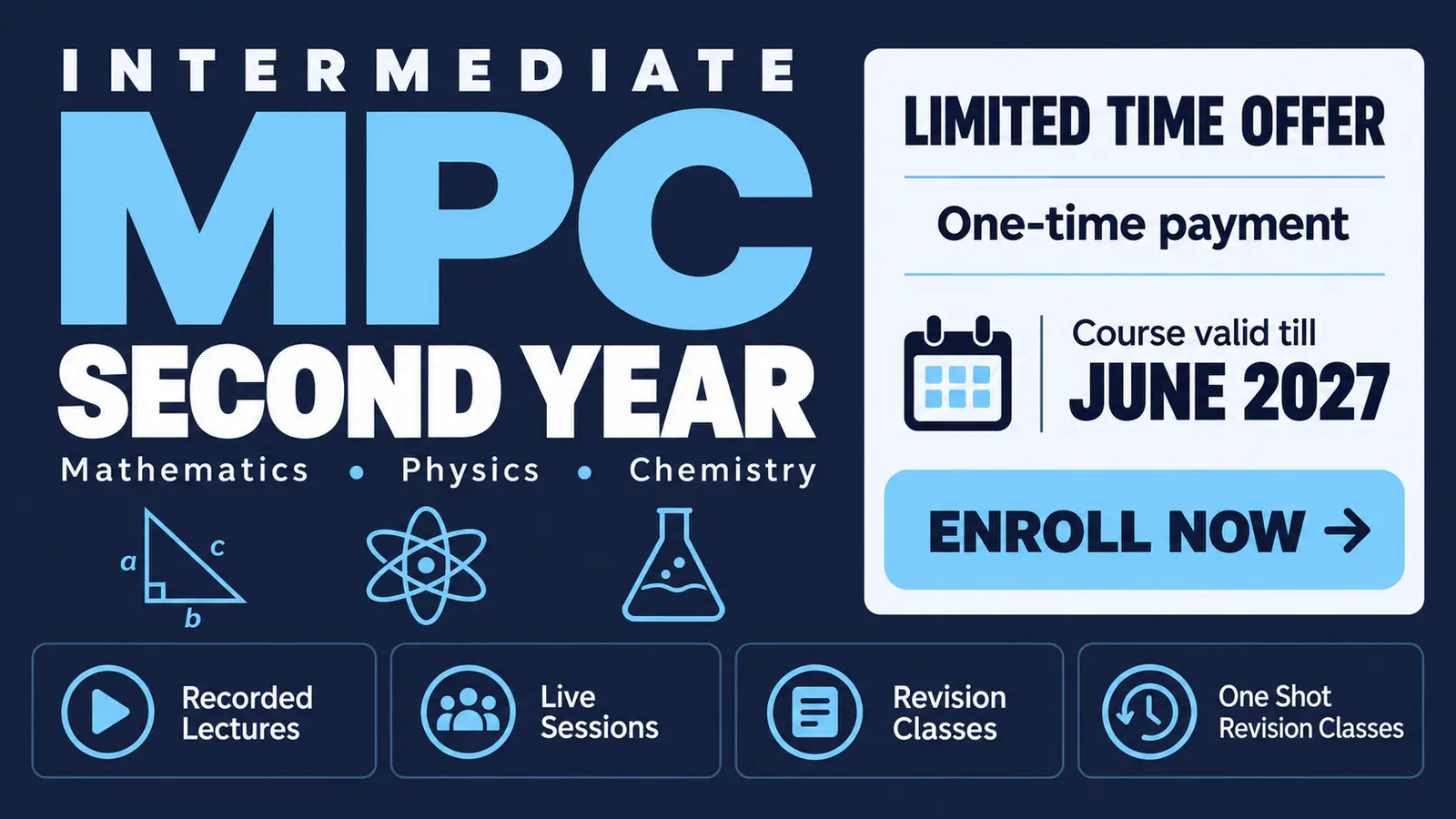
Intermediate MPC Second Year
Prepare for Mathematics, Physics and Chemistry with experienced, expert faculty, easy-to-understand explanations and clear study notes—all at an affordable price. Phase 1 — Syllabus Coverage Till December Complete the syllabus through recorded lectures. Learn at your own pace and revisit lessons whenever you need more clarity. Phase 2 — Complete Revision Until Exams - 3–4 recorded revision lectures per week to strengthen your understanding. - One live session every week to revise the topics covered that week and clear your doubts. - This weekly pattern continues until exams. One-Shot Revision A focused recorded or live revision session will be provided 2–3 days before each respective subject exam. What You Get - Experienced, expert faculty - Easy-to-understand notes and explanations - Weekly live revision and doubt clearing during Phase 2 - Affordable pricing with a one-time payment - Course access valid till June 2027
Curriculum
- Maths IIA
- Complex Numbers
- Complex Numbers Lecture 1
- Complex Numbers Lecture 2 - Exercise 1(b) SAQs
- Lecture 3 – Argument, Modulus–Amplitude Form & Locus of z | Exercise 1(c)
- Lecture 4 - Argand Plane/Diagram, Problems & Exercise 1(d) Important SAQs
- De Moivre's Theorem
- Lecture 1 – De Moivre’s Theorem Basics & Powers of Iota | Important VSAQs & LAQs from Exercise 2(a)
- Lecture 2 – Important LAQs from Exercise 2(a) | Step-by-Step Solutions
- Quadratic Expressions
- Theory of Equations
- Permutations and Combinations
- Permutations and Combinations - Lecture 1
- Permutations and Combinations - Lecture 2
- Permutations and Combinations - Lecture 3
- Lecture 4 – Permutations with Repetition Allowed | Exercise 5(b)
- Lecture 5 – Permutations with Repeated Letters | Important VSAQs from Exercise 5(d)
- Lecture 6 – Combinations: nCr, Important Formulae & VSAQs | Exercise 5(e)
- Binomial Theorem
- Partial Fractions
- Partial Fractions - Lecture 1
- Partial Fractions - Lecture 2 (Type 2 Questions)
- Partial Fractions - Lecture 3 (Type 3 and Type 4 Questions)
- Measures of Dispersion
- Measures of Dispersion - Lecture 1
- Mean Deviation About the Median: Ungrouped & Grouped Data | Important VSAQ
- Probability
- Random Variables and Probability Distributions
- Complex Numbers
- Maths IIB
- Circles
- Circles - Lecture 1
- Circles - Lecture 2
- Circles - Lecture 3
- Circles - Lecture 4
- Circles - Lecture 5 (Exercise - 1(c))
- Lecture 6 – Pole, Polar, Conjugate Points & Lines and Angle Between Tangents | Exercise 1(d)
- Lecture 7 – Exercise 1(e): Important LAQ | Circles Touching Each Other & Point of Contact
- System of Circles
- Parabola
- Lecture 1 – Parabola Basics & Formulae | Standard Equation Derivation: Most Important LAQ
- Lecture 2 – Important LAQs & VSAQs | Exercise 3(a) Solutions
- Ellipse
- Hyperbola
- Integration
- Integration - Lecture 1
- Integration - Lecture 2
- Lecture 3 – Important VSAQs from Exercise 6(c) & Integration by Parts | LAQ Explained
- Lecture 4 – Type 1 Integration & the 9 Special Forms | Important LAQ Concept
- Lecture 5 – Type 2 Integration: Linear Numerator & Quadratic Expressions | Important LAQ
- Lecture 6 – Type 3 Integration: sin x & cos x in the Denominator | Important LAQ
- Lecture 7 – Type 4 Integration: sin x and cos x in the Numerator and Denominator | Most Important LAQ
- Lecture 8 – Type 5 Integration & Integration by Partial Fractions | Solved Problems
- Lecture 9 – Reduction Formulae for Trigonometric Functions & log x | Most Important LAQs
- Definite Integration
- Differential Equations
- Circles
- Physics
- Waves
- Waves - Lecture 1 - Open, Closed Pipe, Stretched Strings
- Ray Optics
- Wave Optics
- Electric Charges and Fields
- Electric Charges and Fields Lecture 1
- Electrostatic Potential and Capacitance
- Lecture 1 - Electric Potential & Potential Difference
- Lecture 2 – Capacitor Basics & Capacitance of a Parallel Plate Capacitor
- Lecture 3 – Capacitors in Series & Parallel: Equivalent Capacitance Derivations | Solved Numerical
- Current Electricity
- Lecture 1 – Kirchhoff’s Laws & Wheatstone Bridge Balance Condition Derivation | Most Important LAQ
- Moving Charges and Magnetism
- Magnetism
- Electromagnetic Induction
- Waves
- Chemistry
- Solid State
- Lecture 1 – Solid State: Crystalline & Amorphous Solids, Crystal Lattice and Unit Cells
- Lecture 2 – Derivation of Bragg’s Equation: Highly Important Short-Answer Question
- Solutions
- Lecture 1 – Solutions Basics & Mole Fraction Problems | Important SAQs
- Lecture 2 – Molarity & Molality Problems | Most Important SAQs
- Surface Chemistry
- Lecture 1 – Adsorption & Catalysis | Physical vs Chemical Adsorption: Most Important Question
- p-Block Elements
- Lecture 1 – Group 15 Elements & Manufacture of Ammonia by Haber’s Process | Important VSAQs & LAQ
- Solid State